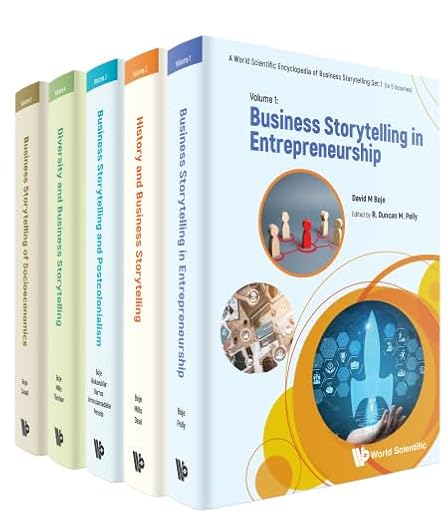
These volumes are working proposals, not fixed assignments. They will be refined collaboratively through the Wednesday Lab as editors and contributors develop the questions, relationships, and chapters that the field requires.
Volume 1 · Working proposal
Generative AI, Quantum Storytelling, and Organizational Futures
Possible editors: David M. Boje and Grace Ann Rosile
Explores quantum antenarratives, living-machine storying, ethical guardrails, and the organizational futures produced when generative systems become actors in sensemaking.
Submitted chapter proposal · Data Analysis and Storytelling in the Age of AI
September 30 agenda · 10-minute presentationReading Stories as Data: Qualimetric and Antenarrative Methods for Studying AI and Organizational Storytelling
Farzaneh Fatemi, University of Tabriz, with D. M. Boje
This submitted chapter is the proposed how-to backbone of the volume: a teachable bridge between data analysis and storytelling. Farzaneh Fatemi will present this chapter proposal for ten minutes at the September 30 World Scientific Encyclopedia Series 3 Working Lab.
Open the chapter proposal, abstract, structure, worked illustrations, and contribution
Abstract
Stories legitimate organizations, move markets, and increasingly reach people already narrated by AI systems — yet narrative is often dismissed as too soft to measure. This chapter presents two complementary, paired traditions: qualimetrics, which codes and counts symbolic patterns, and antenarrative analysis, which reads the unfinished, fragmentary story-strands that counting cannot capture. Together they let a researcher both measure a narrative and interpret how meaning is made, reframed, or suppressed. Written as a practical reference, it introduces the toolkit — discourse coding schemes, structured probe batteries, scoring rubrics (ABCD / ABCD+E), antenarrative reading, and Bakhtinian answerability protocols — and walks step by step through corpus and probe design, coding, AI-assisted verification, and reliability, before showing how to move from counts to meaning. The Ghost Vortex — the leadership shadow embedded in an AI product — serves as a signature illustration of what this reading can surface. Worked cases are drawn from the authors’ research program on AI, storytelling, and answerability. The chapter closes with guidance on studying narrative in the age of AI, where AI is both an analytic aid and an object of study.
How it fits the volume
It is the how-to backbone of the volume — the teachable bridge between “data analysis” and “storytelling.”
Proposed structure
- Why storytelling needs a method now — narratives as organizational reality; the measurement challenge in the AI era.
- Two paired traditions — qualimetrics, counting, and antenarrative analysis, reading the unfinished story.
- The toolkit — discourse coding, probe and protocol batteries, ABCD / ABCD+E scoring rubrics, antenarrative reading, and answerability protocols.
- Designing a study — building a corpus or probe set; turning a narrative grammar into codes.
- Coding in practice — procedure, AI-assisted verification, and establishing reliability.
- From counts to meaning — why frequency alone misleads; the Ghost Vortex as a worked reading.
- Doing it in the age of AI — AI as coder and as object of study; disclosure and ethics.
Worked illustrations from the authors’ research program
- AI Institutional Grammar in Three National Registers — qualimetric discourse coding of AI-legitimacy narratives across US, Chinese, and French–EU corpora.
- Ghost Vortex and AI Moral Answerability — an eight-probe battery and ABCD answerability rubric across named LLM interlocutor threads.
- The AI Storytelling Organization — antenarrative coding of AI story performances via the Ghost Vortex Protocol.
- The Tesseract Leader (XYZA) — the Bakhtinian Answerability Protocol applied to AI corporate leaders.
- Leadership Without Leaders — reading AI artifacts as cultural texts, delegated narrative editing, and the Ghost Vortex.
- Ghost Vortex in the Machine Room — the ABCD+E rubric applied to AI data-center accountability probes.
Contribution
A clear, replicable, teachable method for turning organizational stories into evidence — a reference entry, grounded in a coherent body of studies, that researchers and students can actually follow.
Volume 2 · Working proposal
Narrative Authority, Cognitive Access, and Institutional Legitimacy
Proposed volume editor: Jillian Saylors
Examines AI-supported cognition, disability and neurodiversity, authorship, scholarly labour, expertise, provenance, trust, surveillance, and governance—asking who may think, know, decide, and count as a legitimate knower.
Volume 3 · Working proposal
True Storytelling, DEI, and the Age of AI
Proposed volume editor and contributing author: Oscar Edwards
Investigates diversity, equity, inclusion, belonging, representation, and voice in AI-mediated organizations, using True Storytelling to ask whose experiences are amplified, stereotyped, excluded, or made answerable.
Volume 4 · Working proposal
Human–AI Co-Creation in Entrepreneurship and Strategy
Proposed volume editor: Anton Shufutinsky
Centers human factors, sociotechnical systems, and human-systems integration. Contemporary Sociotechnical Systems Theory provides a path for examining when AI augments rather than displaces human judgment.
Volume 5 · Working proposal
Strategy Storytelling Against Cognitive Surrender
Proposed editor or co-editor: Yue Cai · Introduction in development: Mark Hillon
Draws together strategic renewal, storytelling in multinational corporations, financial-story deconstruction, management ethics and aesthetics, socio-economic world-building, and community-based prosperity. The developing introduction connects these chapters to the Age of AI and positions grounded storytelling as an antidote to cognitive surrender.
Volume 6 · Working proposal
SEAM: Socio-Economic Consultation in the Age of AI
Editorial team to be decided · Amandine Savall, Véronique Zardet, and Marc Bonnet will contribute as editors and/or authors
This volume brings the Socio-Economic Approach to Management (SEAM) into direct conversation with AI transformation. It would examine consultation, hidden costs, untapped human potential, work design, and socially responsible capitalism in organizations adopting AI. Rather than treating technology as a reason for human replacement, the volume would develop practical and answerable ways to co-design AI-enabled change with the people and communities affected by it.